
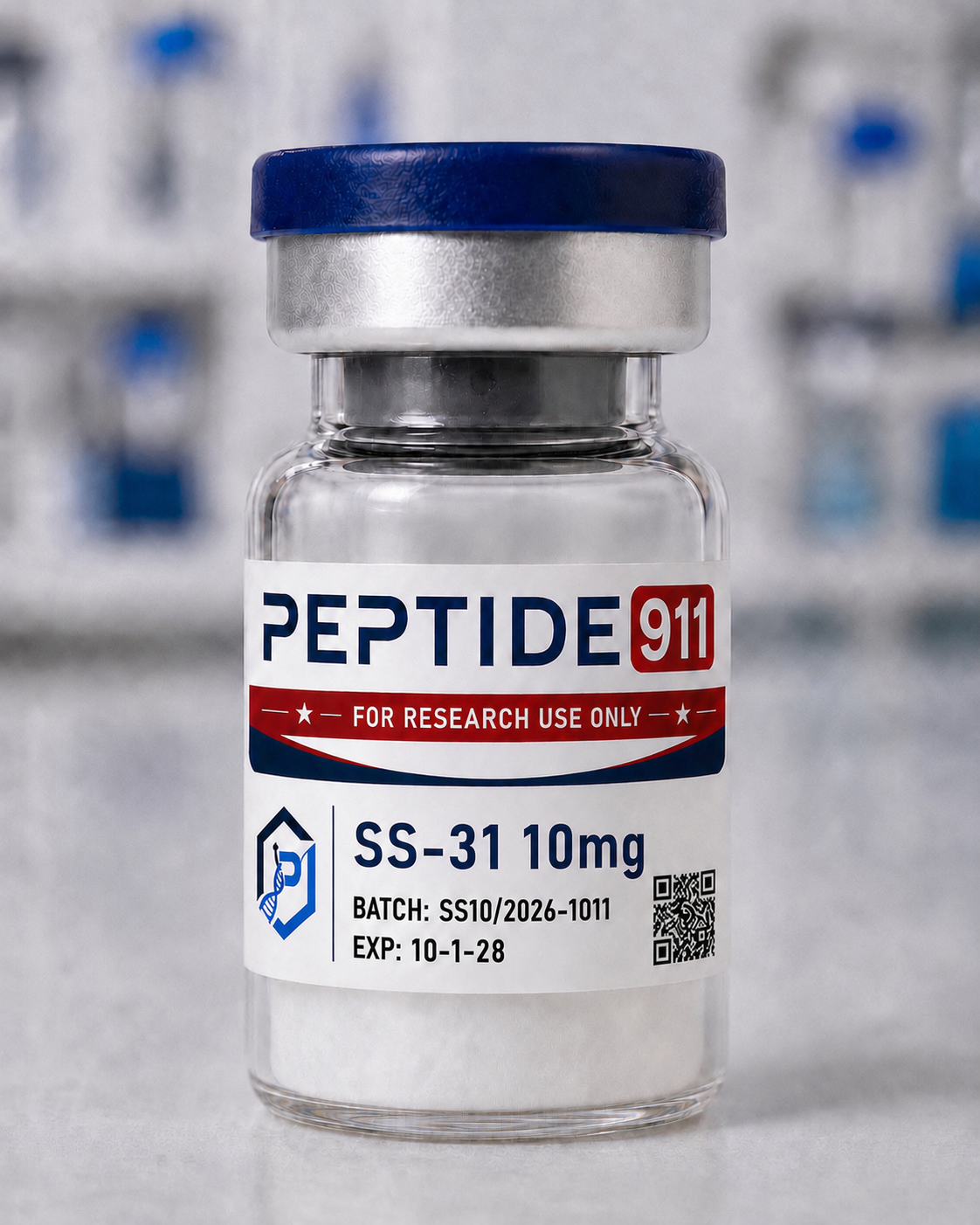
The SS-31 10mg Research Peptide: Complete Product Guide & Scientific Overview
SS-31 10mg Research Peptide. SS-31 (Elamipretide/MTP-131) is a mitochondrial-targeted tetrapeptide undergoing extensive research for its potential to protect mitochondrial function, reduce oxidative stress, and address conditions linked to mitochondrial dysfunction.
This comprehensive guide covers everything researchers need to know about SS-31 10mg research peptide, from its mechanism of action and scientific research applications to product specifications and quality considerations.
What Is SS-31?
Also known as Elamipretide or MTP-131, is a synthetic, cell-permeable tetrapeptide composed of four amino acids with the sequence D-Arg-2’6′-dimethylTyr-Lys-Phe-NH₂. It belongs to the Szeto-Schiller (SS) family of peptides and represents a first-in-class compound designed to selectively target the inner mitochondrial membrane.
Key Product Identifiers
| Parameter | Details |
|---|---|
| Common Names | SS-31, Elamipretide, MTP-131 |
| CAS Number | 736992-21-5 (free base); 1334953-95-5 (acetate salt) |
| Molecular Formula | C₃₂H₄₉N₉O₅ (free base) |
| Molecular Weight | 639.79 g/mol (free base) |
| Amino Acid Sequence | D-Arg-Dmt-Lys-Phe-NH₂ |
| Net Charge | +3 (due to N-terminal amino group, Arg, and Lys residues) |
Mechanism of Action: How SS-31 Works
The therapeutic potential stems from its unique ability to target and protect mitochondria through several distinct mechanisms.
1. Cardiolipin Binding and Membrane Stabilization
SS-31 selectively binds to cardiolipin, a phospholipid exclusively found in the inner mitochondrial membrane. This interaction occurs through:
-
Electrostatic attraction (the peptide’s +3 net charge)
-
Hydrophobic insertion into the membrane
By binding to cardiolipin, SS-31:
-
Prevents cardiolipin from converting cytochrome c into a peroxidase
-
Protects cytochrome c’s electron-carrying function
-
Maintains mitochondrial cristae structure
-
Promotes oxidative phosphorylation
2. Reducing Oxidative Stress
SS-31 has demonstrated dose-dependent scavenging of reactive oxygen species (ROS), including:
-
Hydrogen peroxide
-
Hydroxyl radical
-
Peroxynitrite
The DMT (2,6-dimethyl-L-tyrosine) residue is primarily responsible for its free radical scavenging properties.
3. Preventing Mitochondrial Dysfunction
SS-31 prevents:
-
Mitochondrial depolarization
-
Mitochondrial permeability transition pore formation
-
Ca²⁺-induced mitochondrial swelling
Importantly, SS-31 has no effects on normal mitochondria, suggesting targeted action only under pathological conditions.
4. Novel Mechanism: PLSCR3 Mediation
Recent research has identified phospholipid scramblase 3 (PLSCR3) as a critical mediator of SS-31’s mitochondrial protective effects.
Using genome-wide CRISPR-Cas9 screening, researchers found that PLSCR3 deletion abolishes SS-31’s cytoprotective benefits without affecting baseline injury sensitivity, positioning PLSCR3 as a novel therapeutic target.
SS-31 10mg Product Specifications
Standard Product Content
Research-grade SS-31 is typically supplied as a lyophilized (freeze-dried) powder in vials containing 10mg of the peptide.
| Specification | Standard Requirement |
|---|---|
| Form | White lyophilized powder |
| Purity | ≥95% (HPLC); premium grade ≥98-99% |
| Vial Content | 10mg peptide per vial |
| Storage | -20°C ± 5°C, sealed, protected from light |
| Shelf Life | 24 months when properly stored |
| Grade | Research use only; not for human consumption |
Reconstitution Information
The lyophilized powder requires reconstitution with an appropriate solvent (typically sterile water or bacteriostatic water) before use. Standard practice involves:
-
Adding calculated volume of diluent to achieve the desired concentration
-
Gentle swirling—not shaking—to dissolve
-
Storing reconstituted peptide at the appropriate temperature
-
Using within the recommended timeframe to maintain stability
Scientific Research Applications
SS-31 has been investigated in numerous preclinical models of mitochondrial dysfunction. The 10mg product size is typically used to prepare stock solutions for research applications.
Cardioprotection
SS-31 demonstrates protective effects in cardiac ischemia/reperfusion injury models:
-
Reduces myocardial cell death
-
Improves overall cardiac function
-
Significantly reduces the myocardial infarction area
Neuroprotection and Neuroinflammation
-
Reduces oxidative stress on neurons in neurodegenerative diseases
-
Decreases the accumulation of neuroinflammatory mediators and toxic proteins
-
Exhibits anti-inflammatory, anti-apoptotic, and neuron-survival-promoting effects
In microglial cell studies, SS-31 and its derivatives inhibit LPS-induced inflammatory responses, reducing IL-6, IL-1β, and TNF-α expression.
Ophthalmic Applications
Diabetic Complications:
-
SS-31 (10 mg/kg) reduced epithelial cellular changes in diabetic rat models
-
Improved inner blood-retinal barrier function
-
Reduced retinal microvascular changes
-
Preserved tight junction protein claudin-5 distribution
Glaucoma:
-
SS-31 prevented oxidative stress in glaucomatous trabecular meshwork cells
-
Showed no cytotoxicity at concentrations up to 10⁻⁴ M
-
Prevented hydrogen peroxide-induced oxidative stress at concentrations >10⁻⁹ M
Renal Protection
-
SS-31 shows kidney-protective effects by alleviating mitochondrial dysfunction
-
Demonstrated benefit in various experimental models of kidney disease
Mitochondrial Muscle Injury
In volumetric muscle loss (VML) models:
-
SS-31 (8 mg/kg/day) attenuated ROS emissions at 7 and 14 days post-injury
-
Led to greater mitochondrial respiratory conductance and efficiency out to 30 days
-
Improved antioxidant buffering capacity
Dermatological Research
Recent studies have explored Exo-SS31—SS-31 loaded into milk-derived exosomes—for enhanced bioavailability in mitigating UV-induced photodamage. This delivery strategy:
-
Suppresses ROS production
-
Regulates SOD and GSH levels in skin
-
Inhibits MMP-1/3 expression
-
Prevents collagen degradation
Anti-Aging Research
SS-31’s ability to reduce oxidative stress and cellular damage suggests potential applications in inhibiting aging-related biological processes.
Research Dosage Information
Important Note: The 10mg in product listings refers to the total peptide mass per vial, not a recommended human dose.
Preclinical studies have utilized SS-31 at various dosages depending on the research model:
| Research Model | Dosage | Route | Citation |
|---|---|---|---|
| Diabetic rat model (ophthalmic) | 10 mg/kg | Not specified | |
| Volumetric muscle loss (mouse) | 8 mg/kg/day | Subcutaneous | |
| In vitro cell studies | >10⁻⁹ M (effective); up to 10⁻⁴ M (no cytotoxicity) | Cell culture |
Researchers should determine appropriate concentrations based on their specific experimental design and objectives.
Clinical Development Status
SS-31 has progressed to human clinical trials:
-
Barth Syndrome (TAZPOWER trial, Phase 2/3): SS-31 improved skeletal muscle strength, cardiac output, and quality of life. FDA approval is pending, though the drug is accessible through expanded use programs.
-
Heart Failure, Primary Mitochondrial Myopathy, and Aging-Related Retinal Conditions: SS-31 has been evaluated in these contexts.
-
Translational Challenges: Clinical translation faces hurdles, including limited bioavailability, challenges in establishing effective dosing regimens, incomplete mechanistic understanding, and variability in efficacy across experimental models.
Quality Considerations for Research Peptides
Purity Testing
Premium SS-31 research products should include:
-
HPLC (High Performance Liquid Chromatography) purity analysis (≥95-99%)
-
Mass spectrometry (ESI-MS) verification of molecular weight
-
Third-party lab testing documentation
Manufacturing Standards
Look for products manufactured under:
-
GMP (Good Manufacturing Practice) guidelines
-
ISO 9001 certification
-
USP or BP compliance
Storage and Handling
Proper storage is critical for maintaining peptide integrity:
-
Lyophilized powder: Store at -20°C ± 5°C, sealed, protected from light
-
Reconstituted peptide: Follow manufacturer guidelines; typically requires refrigeration and use within the specified timeframe
-
Shelf life: Up to 24 months when properly stored
Bioavailability and Delivery Challenges
Peptide-based therapeutics like SS-31 face inherent bioavailability limitations:
-
Poor oral bioavailability due to high molecular weight and hydrophilicity
-
Rapid metabolism and enzymatic degradation
-
Short half-lives
Emerging Delivery Strategies
Exosome encapsulation represents a promising approach to enhance SS-31 bioavailability:
-
Milk-derived exosomes show low immunogenicity and high mucosal permeability
-
Exo-SS31 demonstrates greater therapeutic efficacy than SS-31 alone in UV photodamage models
-
This strategy may overcome traditional peptide delivery limitations
Derivatives and Novel Analogues
Recent research has focused on developing SS-31 derivatives with enhanced properties. Nineteen novel derivatives (5a-5s) have been synthesized and evaluated.
Notable findings:
-
5f and 5g exhibited significantly greater anti-inflammatory activity compared to SS-31:
-
Reduced LPS-induced TNF-α levels by 43% and 45% at 10 μM
-
Increased ATP synthesis by 42% and 41% at 50 nM in rotenone-induced cells
-
Attenuated mitochondrial ROS production while preserving mitochondrial integrity
-
These derivatives represent promising avenues for further research in neurodegenerative diseases associated with inflammation and mitochondrial damage.
Summary of Key Research Applications
| Application Area | Key Findings | Citation |
|---|---|---|
| Cardiovascular | Reduces infarction, improves cardiac function | |
| Neurodegenerative | Anti-inflammatory, anti-apoptotic, protects neurons | |
| Ophthalmic | Protects retina, prevents cataracts, treats glaucoma | |
| Renal | Alleviates mitochondrial dysfunction in kidney disease | |
| Muscle Injury | Reduces ROS, improves mitochondrial efficiency | |
| Dermatological | Prevents UV-induced photodamage (with exosome delivery) | |
| Anti-Aging | Reduces oxidative stress and cellular damage |
| Vials | 1 Vial., 2 Vials. ( & syringes), 5 Vials. ( & syringes), 10Vials ( & syringes) . |
|---|
Be the first to review “SS-31 10mg Research Peptide”
Related products
PEPTIDES HEALTH AND WELLNESS
PEPTIDES HEALTH AND WELLNESS
PEPTIDES HEALTH AND WELLNESS
PEPTIDES HEALTH AND WELLNESS
PEPTIDES HEALTH AND WELLNESS
PEPTIDES HEALTH AND WELLNESS
PEPTIDES HEALTH AND WELLNESS
PEPTIDES HEALTH AND WELLNESS
Reviews
There are no reviews yet.