
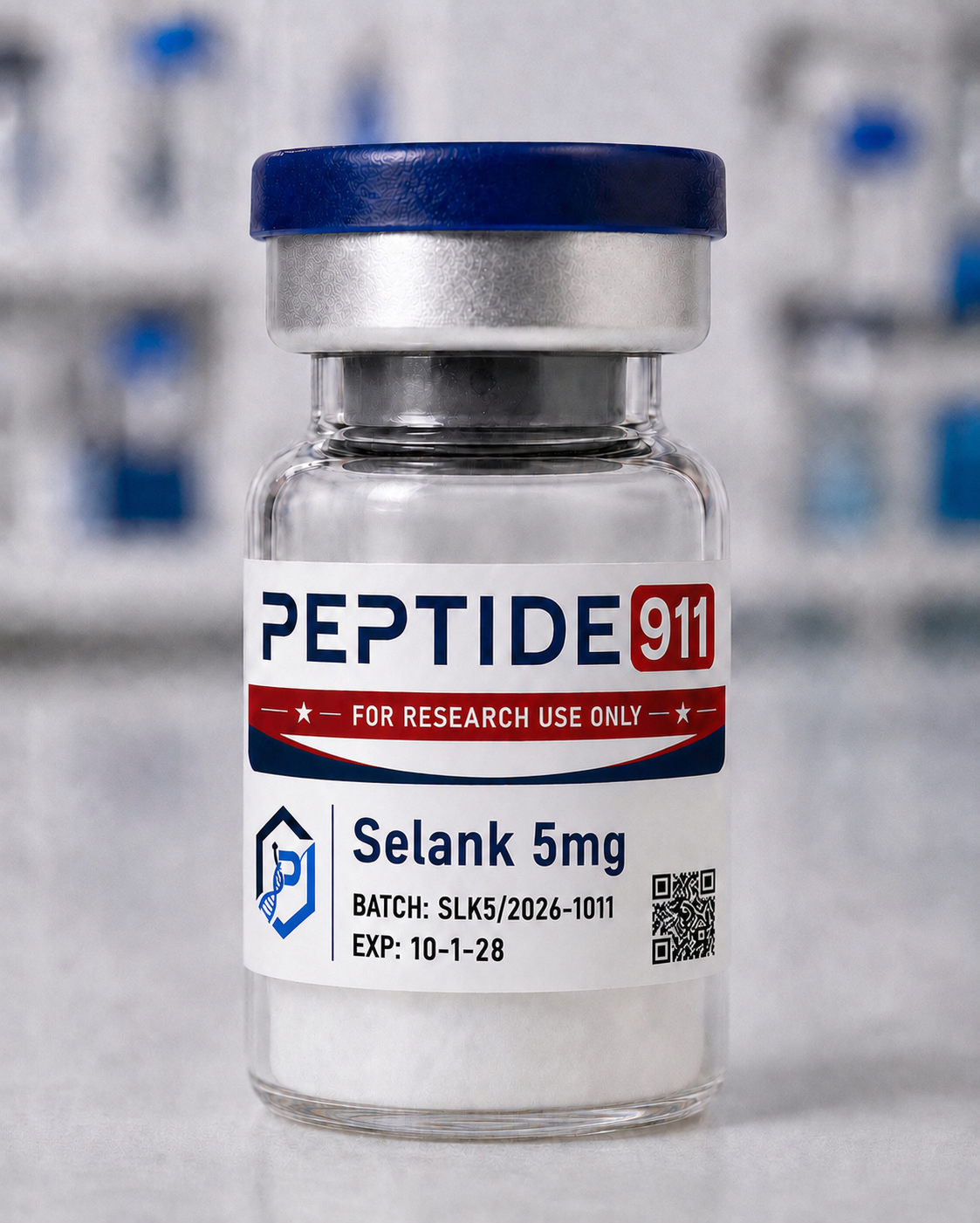
Selank 5mg Research Peptide
Price range: $95.00 through $750.00
Selank is a synthetic peptide with anxiolytic and nootropic properties, originally developed in Russia as an analog of the immunomodulatory peptide tuftsin. This guide provides researchers with comprehensive product information, technical specifications, mechanisms of action, and research applications for Selank 5mg.
Selank 5mg Research Peptide: Complete Product Guide
Selank is a synthetic peptide with anxiolytic and nootropic properties, originally developed in Russia as an analog of the immunomodulatory peptide tuftsin. This guide provides researchers with comprehensive product information, technical specifications, mechanisms of action, and research applications for Selank 5mg.
What Is Selank?
Selank is a synthetic heptapeptide (7 amino acids) derived from the human immunomodulatory peptide tuftsin (Thr-Lys-Pro-Arg). It was developed at the Institute of Molecular Genetics of the Russian Academy of Sciences and has been investigated for its effects on anxiety, cognition, and immune function.
Unlike traditional anxiolytics, Selank does not cause sedation, withdrawal symptoms, or dependence, making it a unique subject for neuropsychiatric research.
Key Product Identifiers
| Parameter | Details |
|---|---|
| Common Names | Selank, Selanc, TP-7 |
| Full Chemical Name | L-Threonyl-L-lysyl-L-prolyl-L-arginyl-L-prolyl-L-prolyl-L-glycinamide |
| Sequence (Single Letter) | TKPRPPG-NH₂ |
| Sequence (Three Letter) | Thr-Lys-Pro-Arg-Pro-Pro-Gly-NH₂ |
| Molecular Formula | C₃₃H₅₇N₁₁O₉ |
| Molecular Weight | ~752.88 g/mol |
| CAS Number | 882091-54-7 |
| Purity (Research Grade) | ≥98-99% (HPLC) |
| Form | Lyophilized powder |
| Storage | -20°C, sealed, protected from moisture and light |
| Shelf Life | 24+ months when properly stored |
Mechanism of Action
Selank’s therapeutic potential stems from its ability to modulate multiple neurotransmitter systems and immune pathways.
1. GABAergic Modulation
Selank acts on the gamma-aminobutyric acid (GABA) system, specifically influencing GABA-A receptors. It increases GABA-mediated inhibitory neurotransmission, producing anxiolytic effects without benzodiazepine-like side effects (sedation, tolerance, dependence).
2. Serotonergic and Dopaminergic Effects
-
Serotonin: Modulates serotonin turnover in the hippocampus and amygdala
-
Dopamine: Influences dopamine metabolism in the frontal cortex and striatum
3. Enkephalin Degradation Inhibition
Selank inhibits enkephalin-degrading enzymes, thereby increasing endogenous enkephalin levels. This contributes to its mood-stabilizing and stress-protective effects.
4. Immune System Modulation
As a tuftsin analog, Selank binds to tuftsin receptors (Tufsin-R) on immune cells, influencing:
-
Cytokine production and balance
-
T-cell and B-cell function
-
Inflammatory responses
5. Brain-Derived Neurotrophic Factor (BDNF)
Research suggests Selank may increase BDNF levels, supporting neuroplasticity, learning, and memory.
6. Oxidative Stress Reduction
Selank demonstrates antioxidant properties, protecting neuronal cells from oxidative damage.
5mg Product Specifications
Standard Product Content
Research-grade Selank is typically supplied as a lyophilized (freeze-dried) powder in vials containing 5mg of the peptide.
| Specification | Standard Requirement |
|---|---|
| Form | White to off-white lyophilized powder |
| Purity | ≥98-99% (HPLC) |
| Vial Content | 5mg peptide per vial |
| Storage | -20°C ± 5°C, sealed, desiccated, protected from light |
| Shelf Life | Up to 24 months when properly stored |
| Grade | Research use only; not for human consumption |
Reconstitution Information
| Solvent | Recommended Concentration | Notes |
|---|---|---|
| Sterile Water (BAC) | 1-2 mg/mL | Standard for injection studies |
| 0.9% Saline | 1-2 mg/mL | Standard for injection studies |
| DMSO | 10+ mg/mL | For in vitro applications |
Reconstitution Protocol:
-
Allow vial to reach room temperature
-
Add 2.5 mL of bacteriostatic water to achieve 2 mg/mL concentration (or 5 mL for 1 mg/mL)
-
Gently swirl until completely dissolved
-
Store reconstituted solution at 2-8°C for short-term use
How Many Doses in a 5mg Vial?
A 5mg vial contains enough peptide for multiple research applications depending on the experimental design.
| Dose | Use | Doses per 5mg Vial |
|---|---|---|
| 100-250 µg | Standard anxiolytic research dose (in vivo) | 20-50 doses |
| 300-500 µg | Moderate research dose | 10-16 doses |
| 1 mg | Higher research dose | 5 doses |
| 100-500 µM | In vitro cell studies | Varies by cell culture |
Research Applications
Selank has been investigated across numerous preclinical and clinical research areas:
1. Anxiety and Stress Research
Selank’s most well-documented application is in anxiety research:
-
Clinical trials: Demonstrated efficacy comparable to benzodiazepines in generalized anxiety disorder (GAD)
-
Stress models: Reduces stress-induced behavioral and biochemical changes in rodents
-
No sedation: Unlike benzodiazepines, Selank does not impair motor coordination or cognition
| Study Model | Dose | Effect |
|---|---|---|
| Elevated plus maze (rodent) | 0.1-0.5 mg/kg | Increased time in open arms |
| Social interaction test | 0.3 mg/kg | Increased social behavior |
| Forced swim test | 0.5 mg/kg | Reduced immobility |
2. Cognitive Enhancement (Nootropic Effects)
Selank has demonstrated cognitive-enhancing properties:
-
Learning and memory: Improves acquisition and retention in various memory tasks
-
Neuroplasticity: Upregulates BDNF and other neurotrophic factors
-
Attention: Enhances attentional processes and executive function
-
Protection: Protects against stress-induced cognitive impairment
3. Neuroprotection and Neurodegenerative Disease
Selank shows potential in protecting neuronal health:
-
Oxidative stress: Reduces ROS and lipid peroxidation
-
Excitotoxicity: Protects against glutamate-induced neuronal damage
-
Ischemia: Demonstrates protective effects in cerebral ischemia models
-
Neuroinflammation: Modulates inflammatory responses in the CNS
4. Immune Modulation
As a tuftsin analog, Selank influences immune function:
-
Cytokine balance: Modulates pro- and anti-inflammatory cytokines
-
NK cell activity: Influences natural killer cell function
-
Phagocytosis: Enhances macrophage activity
-
Autoimmune models: Investigated in autoimmune disease research
5. Addiction and Substance Use Research
Preliminary studies suggest Selank may reduce:
-
Alcohol preference in animal models
-
Opioid withdrawal symptoms
-
Stress-induced drug-seeking behavior
6. Dermatological Research
Selank’s anti-inflammatory and immunomodulatory properties are being explored in:
-
Wound healing applications
-
Inflammatory skin conditions
Dosing Information for Research
In Vivo Research (Rodent Models)
| Application | Typical Dose Range | Route |
|---|---|---|
| Anxiety studies | 0.1-0.5 mg/kg | Intraperitoneal (IP), Subcutaneous (SC) |
| Cognitive studies | 0.1-0.5 mg/kg | IP, SC |
| Neuroprotection | 0.5-1.0 mg/kg | IP, SC |
| Immune modulation | 0.3-1.0 mg/kg | IP, SC |
In Vitro Research
| Application | Typical Concentration | Notes |
|---|---|---|
| Cell viability | 1-100 µM | Depends on cell type |
| Receptor binding | 0.1-10 µM | Competitive binding studies |
| Cytokine assays | 1-50 µM | Concentration-dependent effects |
Solubility and Stability
Solubility Profile
| Solvent | Solubility |
|---|---|
| Water | >10 mg/mL |
| Saline | >10 mg/mL |
| DMSO | >20 mg/mL |
| Ethanol | Slightly soluble |
Stability Guidelines
Lyophilized powder:
-
Store at -20°C (stable for 24+ months)
-
Avoid frequent freeze-thaw cycles
-
Protect from moisture and light
Reconstituted solution:
-
Store at 2-8°C for up to 14 days
-
Store at -20°C for extended storage (aliquot to avoid freeze-thaw)
-
Use sterile techniques during preparation
Research-Grade Quality Standards
Specifications to Verify
| Parameter | Specification |
|---|---|
| HPLC Purity | ≥98-99% |
| Mass Spectrometry | [M+H]+ = ~752.88 m/z (verify sequence) |
| Appearance | White to off-white powder |
| Water Content | <5% |
| Endotoxin | <1 EU/mg |
| Bacterial Count | <100 CFU/g |
Certificate of Analysis (COA) Requirements
Premium research products should include:
-
HPLC chromatogram
-
Mass spectrometry spectrum
-
Amino acid analysis
-
Endotoxin and sterility testing
-
Batch-specific documentation
Structural Characteristics
Selank’s structure incorporates several features that contribute to its biological activity:
| Position | Amino Acid | Role |
|---|---|---|
| 1 | L-Threonine (Thr) | N-terminal; receptor interaction |
| 2 | L-Lysine (Lys) | Tuftsin homology region |
| 3 | L-Proline (Pro) | Tuftsin homology region |
| 4 | L-Arginine (Arg) | Tuftsin homology region; tuftsin receptor binding |
| 5 | L-Proline (Pro) | Conformational stabilization |
| 6 | L-Proline (Pro) | Conformational stabilization |
| 7 | L-Glycinamide (Gly-NH₂) | C-terminal amide; receptor binding |
The C-terminal amide group enhances stability by providing resistance to carboxypeptidase degradation.
Clinical Development Status
Selank has undergone clinical research in Russia and other countries:
-
Approved in Russia: Selank nasal spray (0.15%) is approved for generalized anxiety disorder and depression
-
Phase II/III Trials: Investigated for anxiety, stress-related conditions, and cognitive impairment
-
Safety Profile: Demonstrates low toxicity and minimal side effects in clinical trials
-
Patents: Several patents filed for Selank and its analogues
Potential Research Limitations
| Limitation | Consideration |
|---|---|
| Bioavailability | Short half-life (~15-30 minutes); peptide administration routes limited |
| CNS Penetration | May cross BBB via tuftsin receptors, but optimization needed |
| Analog Development | More stable analogues are being developed |
| Clinical Trial Data | Limited rigorous clinical trial data outside Russia |
Summary of Key Research Applications
| Application Area | Key Findings | Citation |
|---|---|---|
| Anxiety Research | Comparable to benzodiazepines; no sedation or dependence | Clinical trials (Russia) |
| Cognitive Enhancement | Improves learning and memory; upregulates BDNF | Rodent studies |
| Neuroprotection | Reduces oxidative stress and excitotoxicity | In vitro & in vivo |
| Immune Modulation | Tuftsin receptor binding; cytokine modulation | In vitro & in vivo |
| Addiction Research | Reduces alcohol preference and opioid withdrawal | Rodent studies |
| Dermatological | Wound healing and anti-inflammatory effects | Preclinical studies |
Handling and Safety
Personal Protective Equipment (PPE)
-
Gloves, safety goggles, and lab coat when handling
-
Work in a fume hood when weighing powder
Waste Disposal
-
Dispose of unused peptide and contaminated materials as chemical waste according to institutional guidelines
| Vials | 5 Vials., 10 Vials(& syringes)., 20 Vials(& syringes)., 50 Vials (& syringes). |
|---|
Be the first to review “Selank 5mg Research Peptide”
Related products
PEPTIDES HEALTH AND WELLNESS
PEPTIDES HEALTH AND WELLNESS
PEPTIDES HEALTH AND WELLNESS
PEPTIDES HEALTH AND WELLNESS
PEPTIDES HEALTH AND WELLNESS
PEPTIDES HEALTH AND WELLNESS
PEPTIDES HEALTH AND WELLNESS
PEPTIDES HEALTH AND WELLNESS
Reviews
There are no reviews yet.